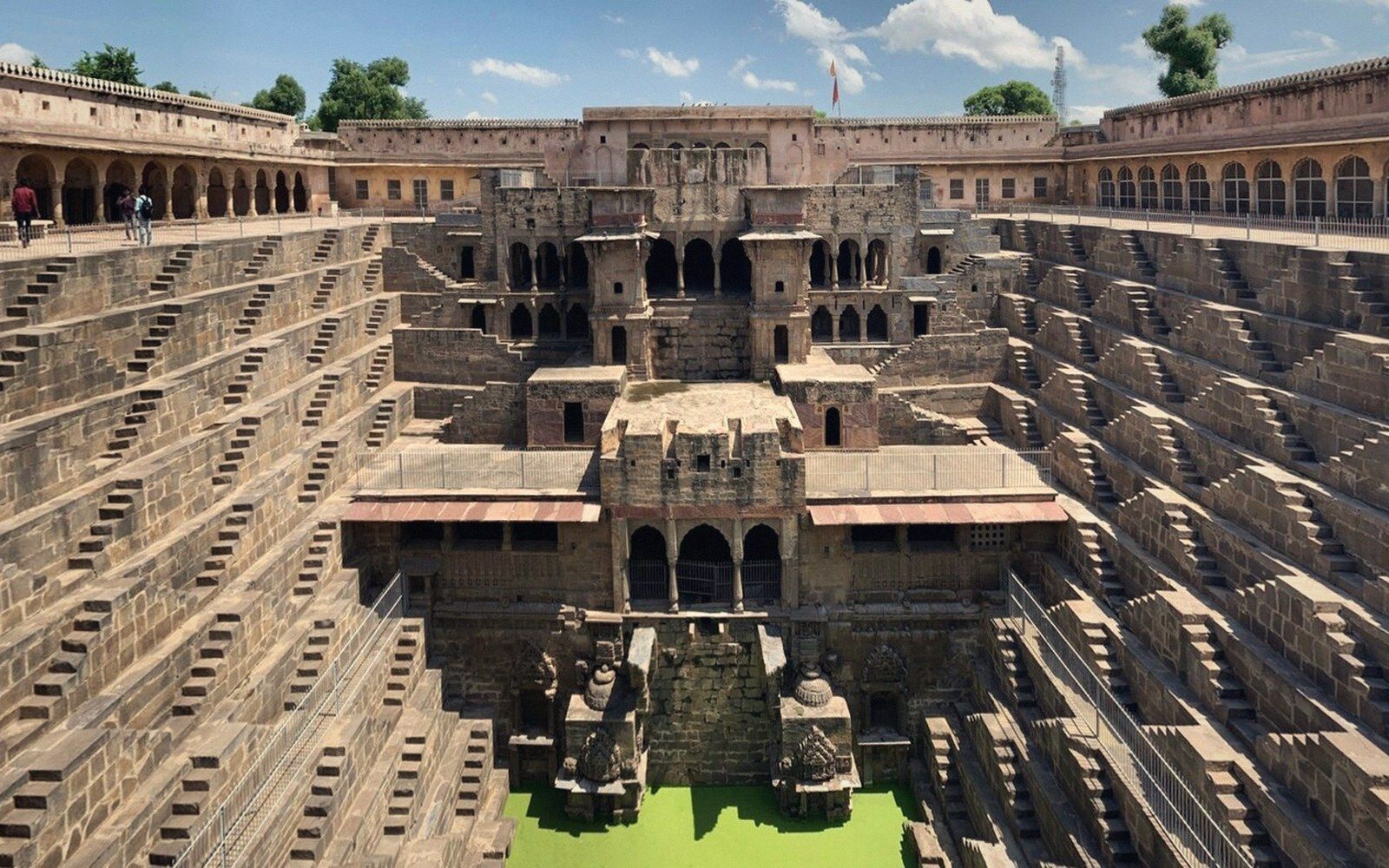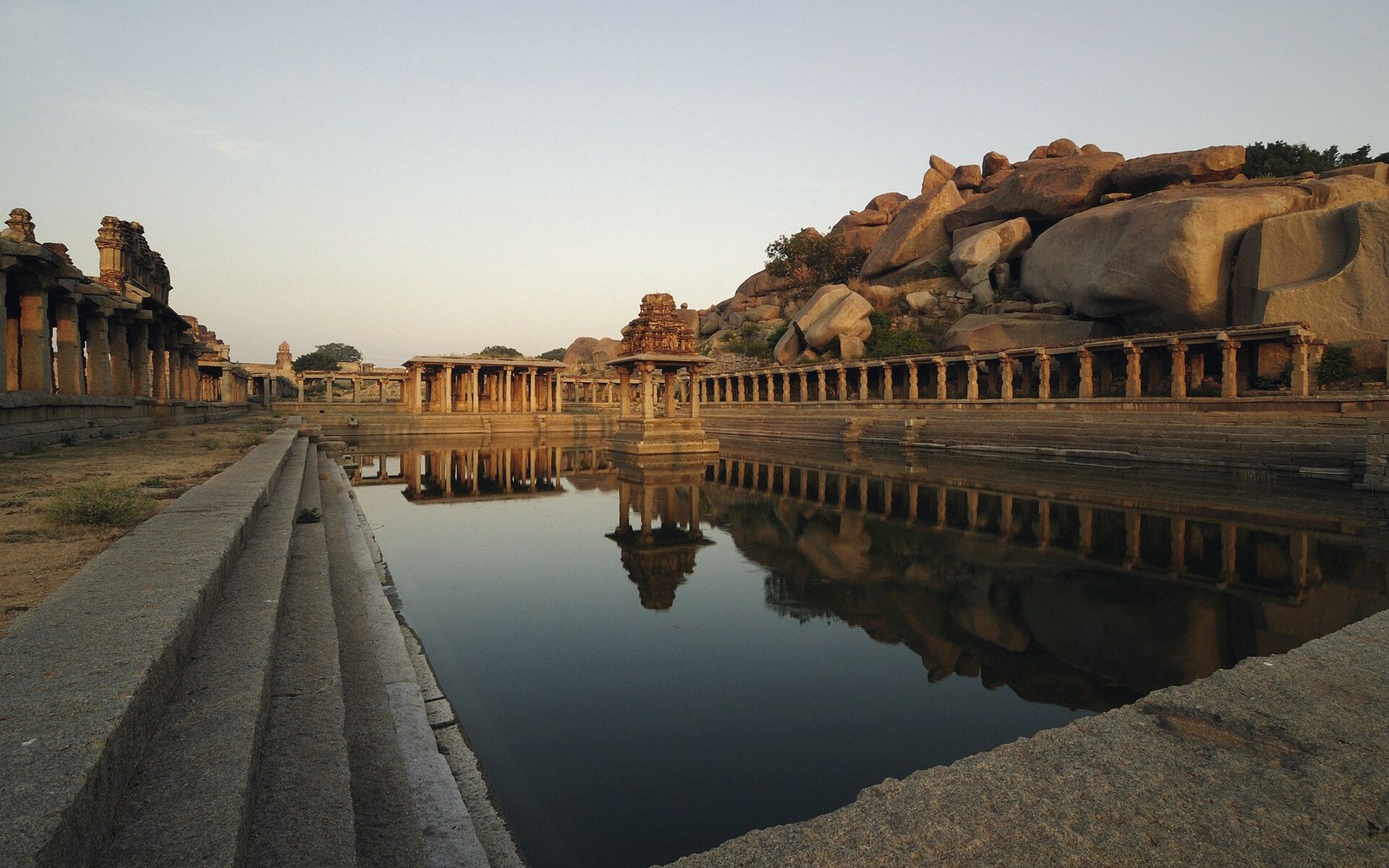
In the Deccan and across much of peninsular India, a temple tank is not a simple reservoir. It is a precisely cut granite basin — sometimes square, sometimes cross-shaped in plan — whose interior walls descend in tier after tier of dressed stone steps to the waterline. Every face is the same: steps on all four sides, meeting at identical projecting staircase arms that push into the water from each corner or cardinal point. The geometry is exact, and it is deliberate. The tank is not an afterthought to the temple; it is a structural and ritual argument made in stone.
These tanks go by several names depending on region and language — pushkarini or kalyani in Kannada-speaking areas, teppakulam further south — but the Deccan tradition built in granite is among the most architecturally rigorous of all. The Hoysala-period tanks of Karnataka, and those associated with the great Vijayanagara city at Hampi, set the standard. At Hampi, the Pushkarani near the Vittala temple complex is a textbook example: a square-plan tank with stepped sides dropping in sharp horizontal courses, each course a single dressed block wide, the whole interior resembling a negative ziggurat. The water, when present, simply mirrors the geometry back.
01What the steps are actually for
The practical logic is elegant. A tank in a monsoon climate fills and drains; the water table shifts through the year, and a reservoir with sheer walls is useless at two-thirds capacity — no one can reach the water. Stepped sides mean access at any level. The steps also serve as washing platforms, as bathing ghats, and as the surface along which a procession descends to collect water for ritual use. In the grander tanks of the Vijayanagara period, intermediate platforms and small pavilions or mandapa were built into the step sequence, so the descent itself became a processional architecture.
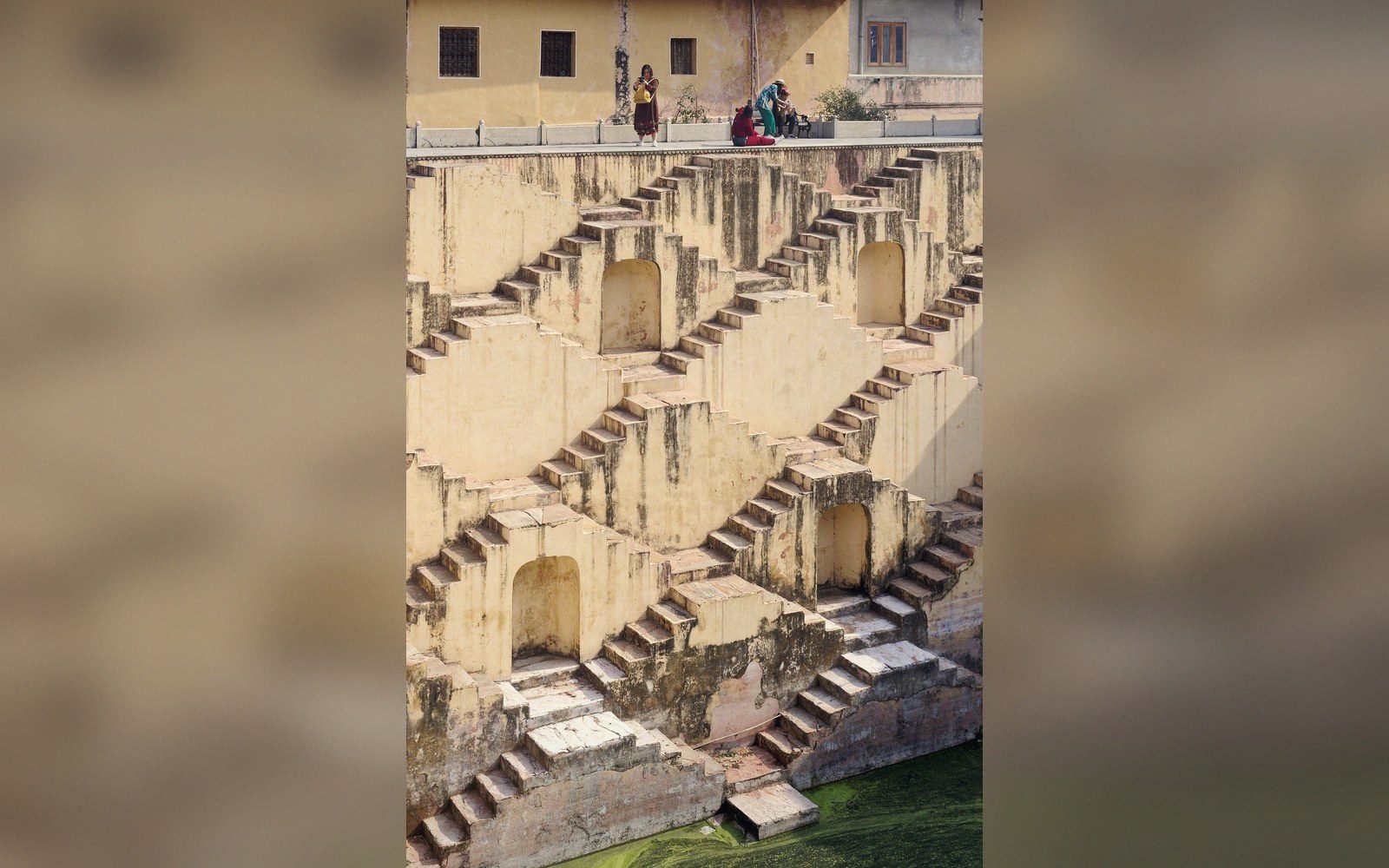
The granite that defines these tanks is not incidental to their character. The Deccan sits on one of the oldest geological formations on earth, the Deccan Traps excepted — the underlying Archaean gneisses and granites have been quarried and worked here for millennia. Granite resists water penetration well and holds its edge under the abrasion of bare feet over centuries. The joints between courses in a well-built tank are tight enough that the structure is largely self-sealing; the stepped form distributes load without requiring mortar in the European sense. Where mortar was used, it was often a lime-jaggery compound that hardened underwater.
The proportional grammar of these tanks is closely related to the planning conventions of the temple itself. A pushkarini is typically sited on the temple's east or north axis; its ground plan uses the same modular grid — tala measurements — that governs the shrine's base mouldings and tower. Axis, proportion and orientation are shared across temple and tank as a single spatial system. The tank is, in that sense, an extension of the plan and mouldings that govern the whole complex, translated into landscape.
02The Vijayanagara refinement
The fourteenth to sixteenth centuries, when Vijayanagara ruled much of the peninsula, saw the stepped tank brought to its greatest complexity. Royal enclosures at Hampi contain tanks whose stepped interiors are broken by projecting stairways on all four sides, creating a cross-shaped water surface ringed by descending staircase arms. Others are rectangular with elaborate corner pavilions whose columns stand directly in the water at high fill — a theatrical device that only works because the step geometry keeps the column bases accessible for maintenance when the tank drains. The so-called Royal Enclosure tank at Hampi, a stepped tank quite distinct from the enclosed bathing buildings elsewhere at Hampi, shows how refined this integration of platform, column and water had become.
Later Nayaka-period building in Tamil Nadu and Andhra carried the tradition forward, enlarging the tanks to the vast teppakulam scale — some large enough to float rafts during festival — while retaining the same cardinal-axis step geometry. The form changed in scale but not in principle. What began as a practical solution to a fluctuating water table had become, by the sixteenth century, one of the most spatially sophisticated forms of Indian hydraulic architecture.
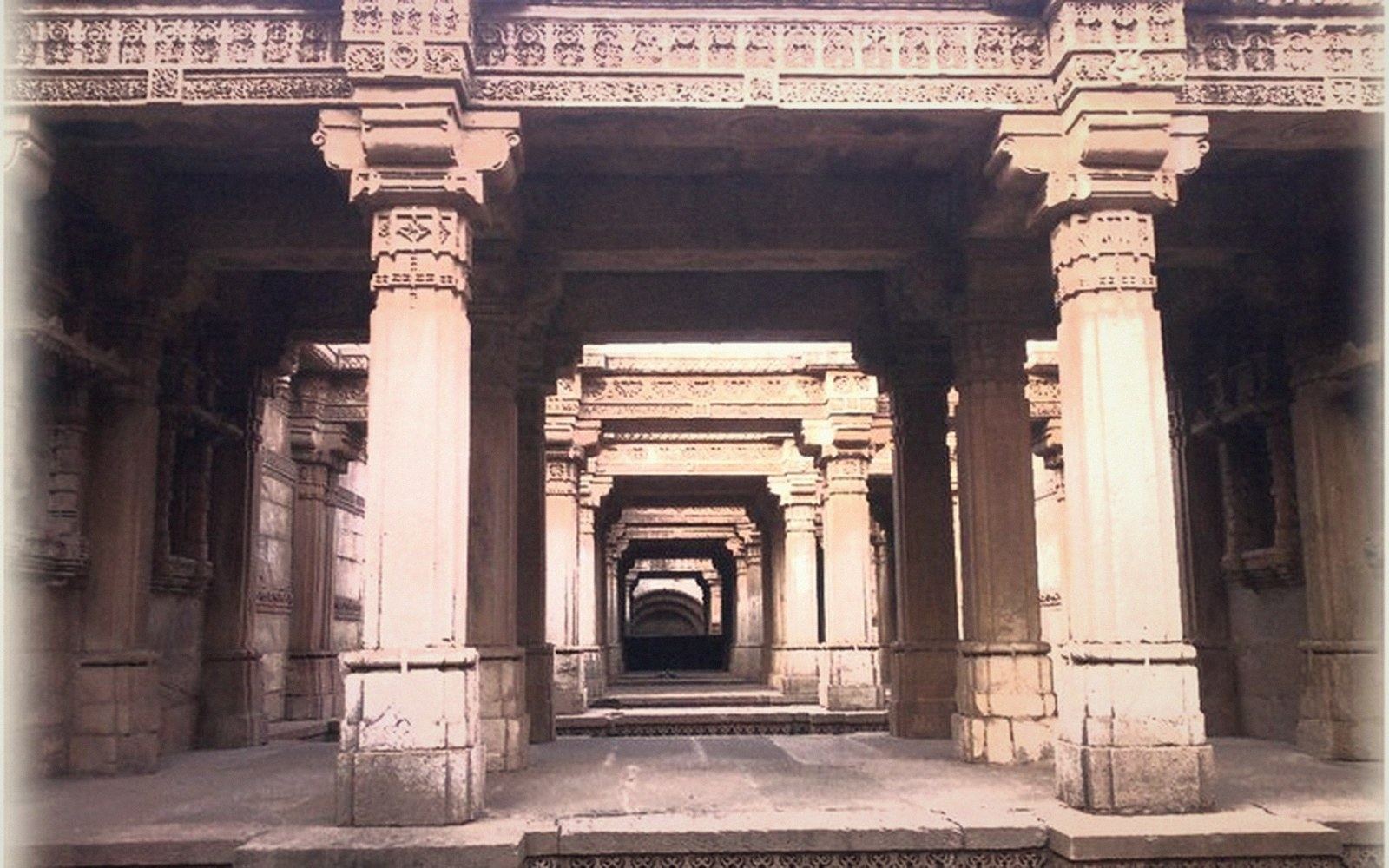
The Hoysala-period tanks of Karnataka, and those associated with the great Vijayanagara city at Hampi, set the standard.