
Stepwells and tanks spanned by projecting stone, not by arch: the structural logic that determines every dimension.
A true arch distributes load in compression around a curve, which allows it to span widely without great depth of material. Corbelling works differently. Each successive stone projects slightly beyond the one below it, cantilevering inward until two opposing corbels meet, or a flat beam bridges the remaining gap. The spanning stone carries bending stress, not pure compression, and stone is weak in bending. This single fact governs the proportions of almost every stepwell built in the subcontinent.
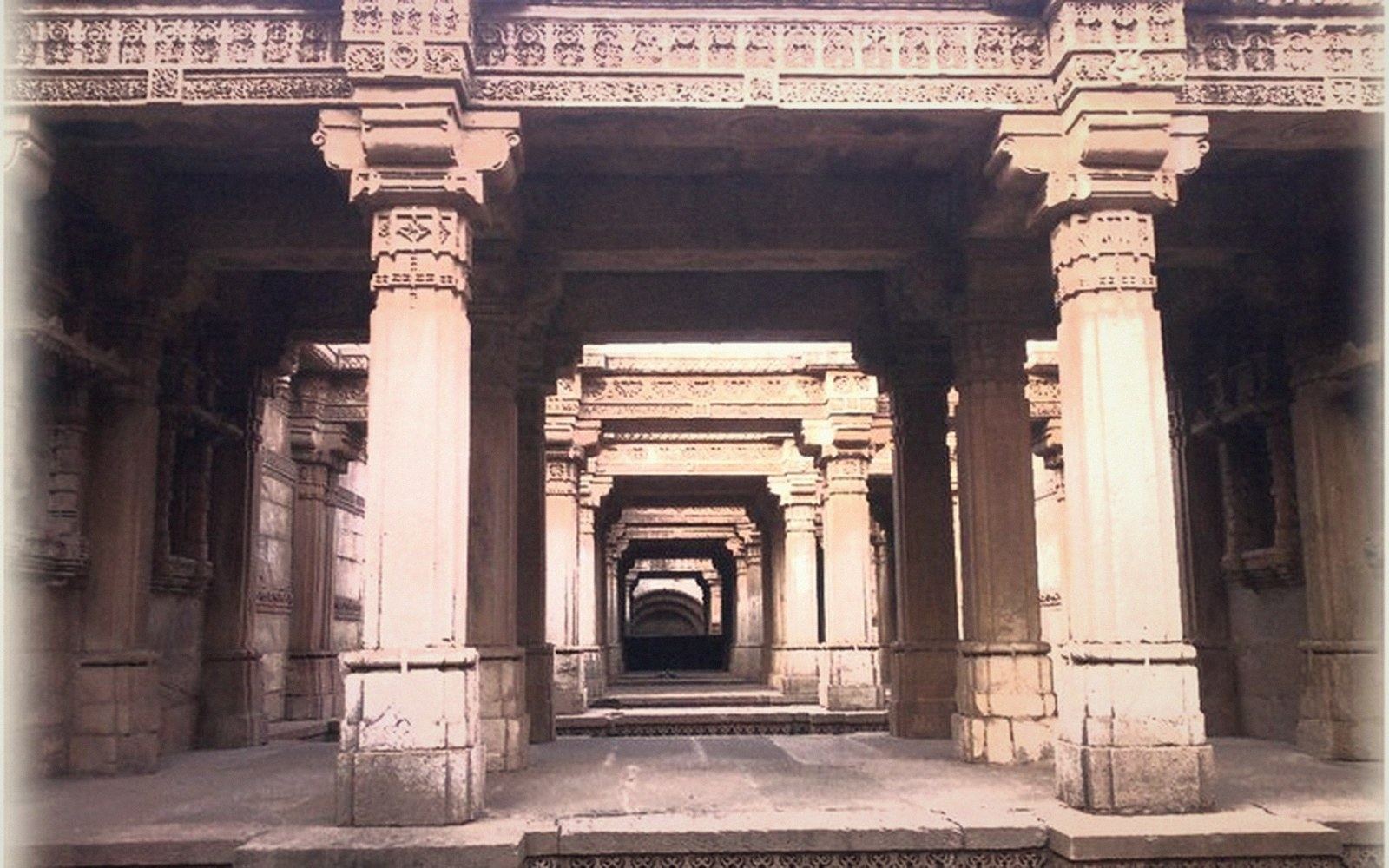
The practical ceiling is determined by the quality of the stone and the weight above it. Sandstone corbels in Rajasthan and Gujarat can project several centimetres per course without fracture, but only up to a point; beyond it, the lever arm becomes too great and the stone splits or shears. Builders compensated in two ways. They chose stone with a fine, consistent grain — the pale buff sandstone of the Thar region was quarried partly for this quality. And they kept spans short, which is why the corridors and galleries in a vav (the Gujarati term for a stepwell with a long axial passage) are narrow relative to their height. The columns stand close together not for ritual reasons but for structural ones.
This also explains the depth of the corbelled brackets that cap the columns. A bracket extending well beyond the column face reduces the clear span the beam above must cross; the beam then sits in a more favourable stress condition and can be thinner. The carved elaboration of those brackets — the angled struts, the figural corbels, the layered projections — is ornament, but it is ornament that follows structural logic rather than contradicting it.
Granite, used widely in the Deccan for stepped tanks and temple reservoirs, is harder to carve into deep projections but carries bending stress better than sandstone. Builders in the south consequently used flatter bracketing and relied more on the beam's own strength. The effect is austere compared with the carved galleries of Rajasthan, which is a direct consequence of material, not aesthetic preference.
Where a staircase descends through multiple storeys into the earth, the problem compounds. Each landing level must be roofed and its own corbelled ceiling must carry the weight of stone steps above it. The builders who managed this — at Rani ki Vav in Patan, at Chand Baori in Abhaneri — were solving a stacking structural puzzle that demanded consistent quality of both material and execution across many courses of stone laid without mortar or iron.
A true arch distributes load in compression around a curve, which allows it to span widely without great depth of material.