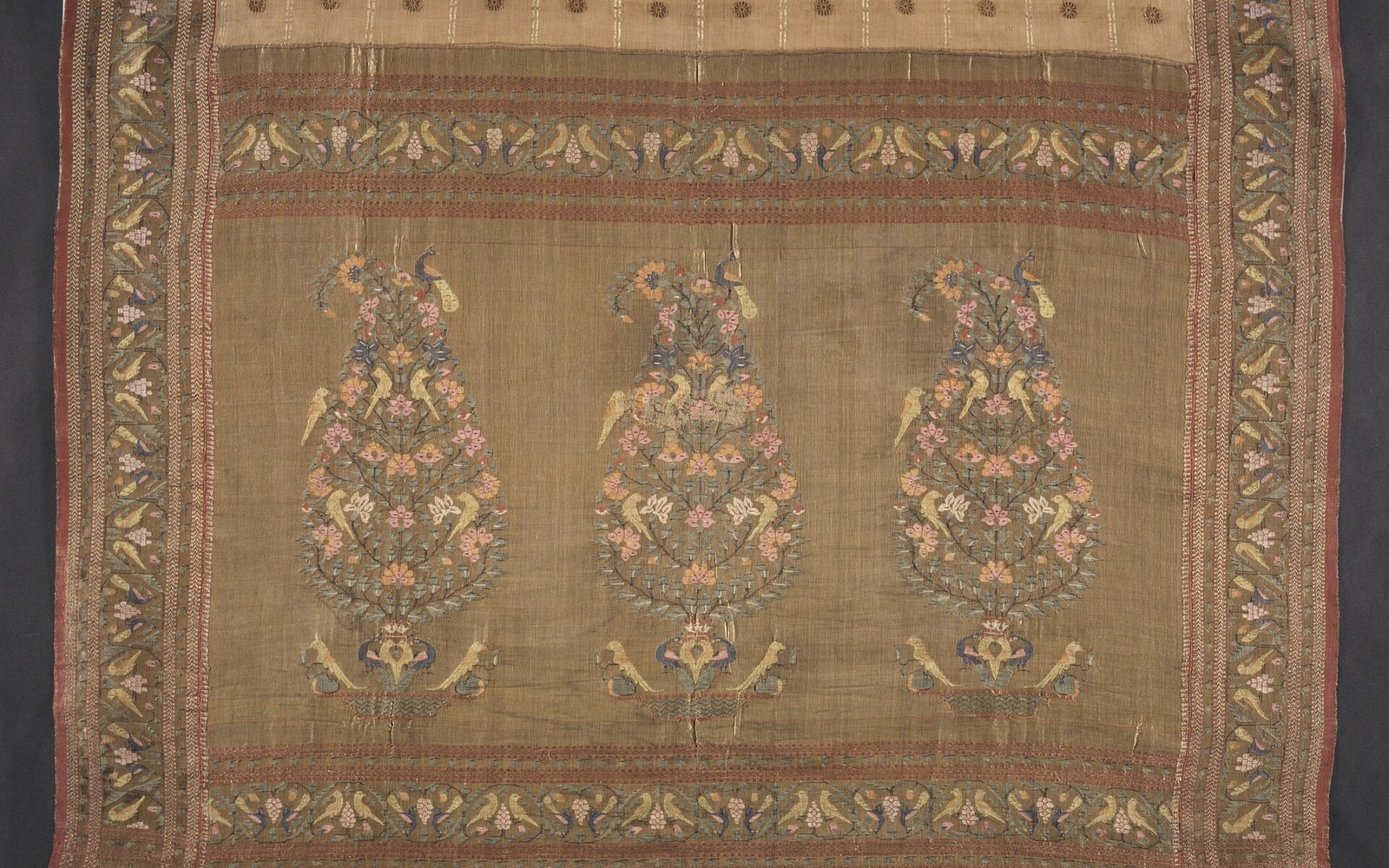
The border on a Paithani sari is not printed, embroidered or added after weaving — it is built into the cloth at the loom, stitch by stitch, in a technique quite different from the body of the fabric.
The field of a Paithani — that lustrous silk woven in Paithan, Maharashtra, on the Godavari river — is plain or lightly patterned, worked in a straightforward plain weave with a continuous weft. The border is something else. It is woven in tapestry technique: small, discontinuous wefts of coloured or zari (gold or silver wrapped thread) yarn that travel back and forth only within their own colour zone, rather than running edge to edge across the full width of the cloth. Each colour block is built up independently and then locked to its neighbour at the boundary. The result looks continuous from the face but is structurally distinct from everything around it.
This is true tapestry logic — the same principle that runs through Central Asian kilims and European high-warp tapestries, adapted here to silk and metal thread in a narrow vertical band. Because the weft does not pass through the full shed, the weaver works the border section more slowly and with greater manual attention than the body, effectively weaving two different cloths side by side and joining them as they grow.
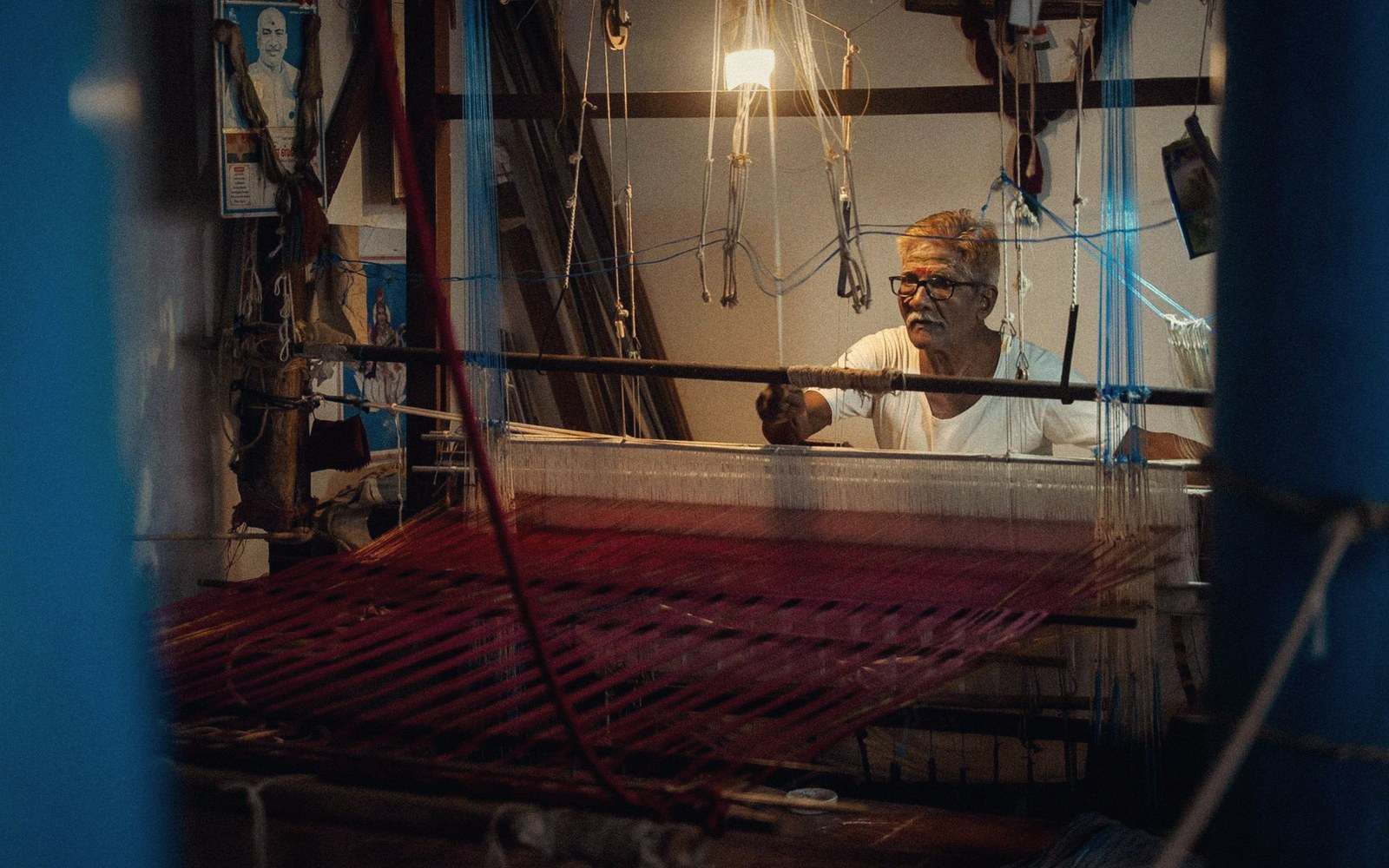
The motifs traditional to Paithani borders — the asawali (flowering vine), the kalas (pot-and-leaf repeat), angular peacocks — are only possible because of this technique. A continuous weft cannot sustain a small, dense, colour-separated motif without the colours muddying into each other or requiring complex floats. Tapestry weave keeps each colour clean and precisely placed. Width matters too: a Paithani border is typically narrow, which means the tapestry sections are short; the weaver's shuttle or needle reverses constantly, building the pattern row by patient row.
The same structural principle appears in other South Asian traditions. Borders on certain Chanderi and Maheshwari saris from Madhya Pradesh carry discontinuous supplementary wefts in the border band, as do some of the figured borders of Kashmiri shawl cloth. The technique is not unique to any one centre, but Paithan is where it reached its most refined expression in silk combined with zari, producing a border whose visual density — deep colour, metallic shimmer, tightly packed imagery — sits in deliberate contrast to the open luminosity of the field.
The border, in other words, is not decoration applied to a finished cloth. It is a structural decision made at the loom before a single pick of the main field is laid in.
Each colour block is built up independently and then locked to its neighbour at the boundary.