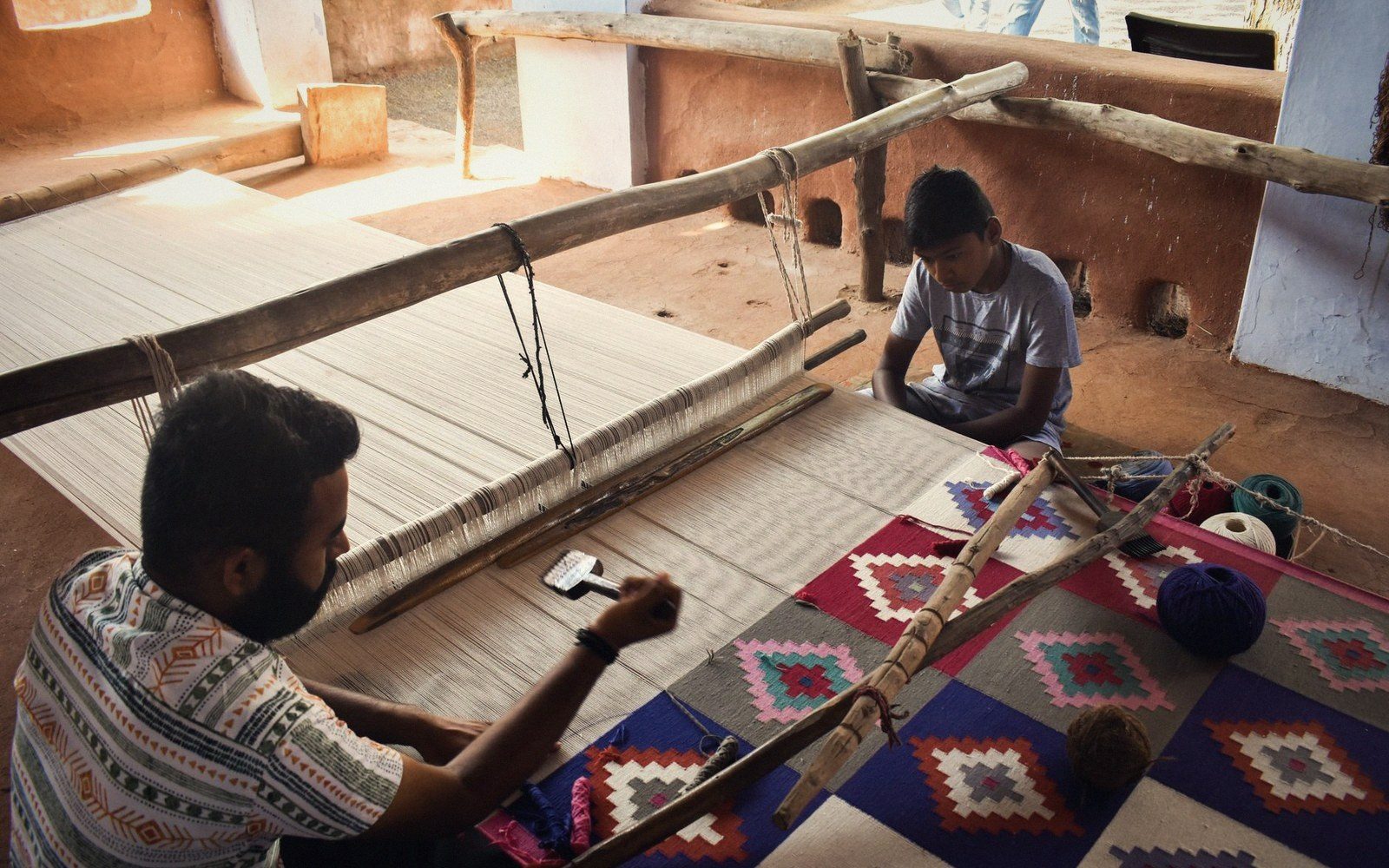
A loom holds warp threads under tension so the weaver can pass weft through them — that is all a loom is. The mechanism that lifts and separates the warp determines everything else: the cloth's structure, its scale, its capacity for ornament.
The pit loom, worked across much of India, is set into a trench in the floor. The weaver sits at ground level with legs below, feet operating the treadles that lift heddles and open the shed — the gap through which the shuttle passes. Low to the ground and braced by the earth itself, it is a stable, quiet tool suited to plain and simple-patterned cloth. Its limitation is width: the weaver can only throw the shuttle as far as both arms reach.
The frame loom, elevated above the floor and common in handloom workshops from Bengal to Tamil Nadu, works on the same principle but sits in an open timber frame rather than a pit. This raises the work into easier reach and makes it somewhat simpler to modify for extra pattern shafts, but it does not fundamentally change what the mechanism can produce. Neither pit nor frame loom can lift individual warp threads selectively — they can only group threads and raise groups together. That constraint is the ceiling of their complexity.
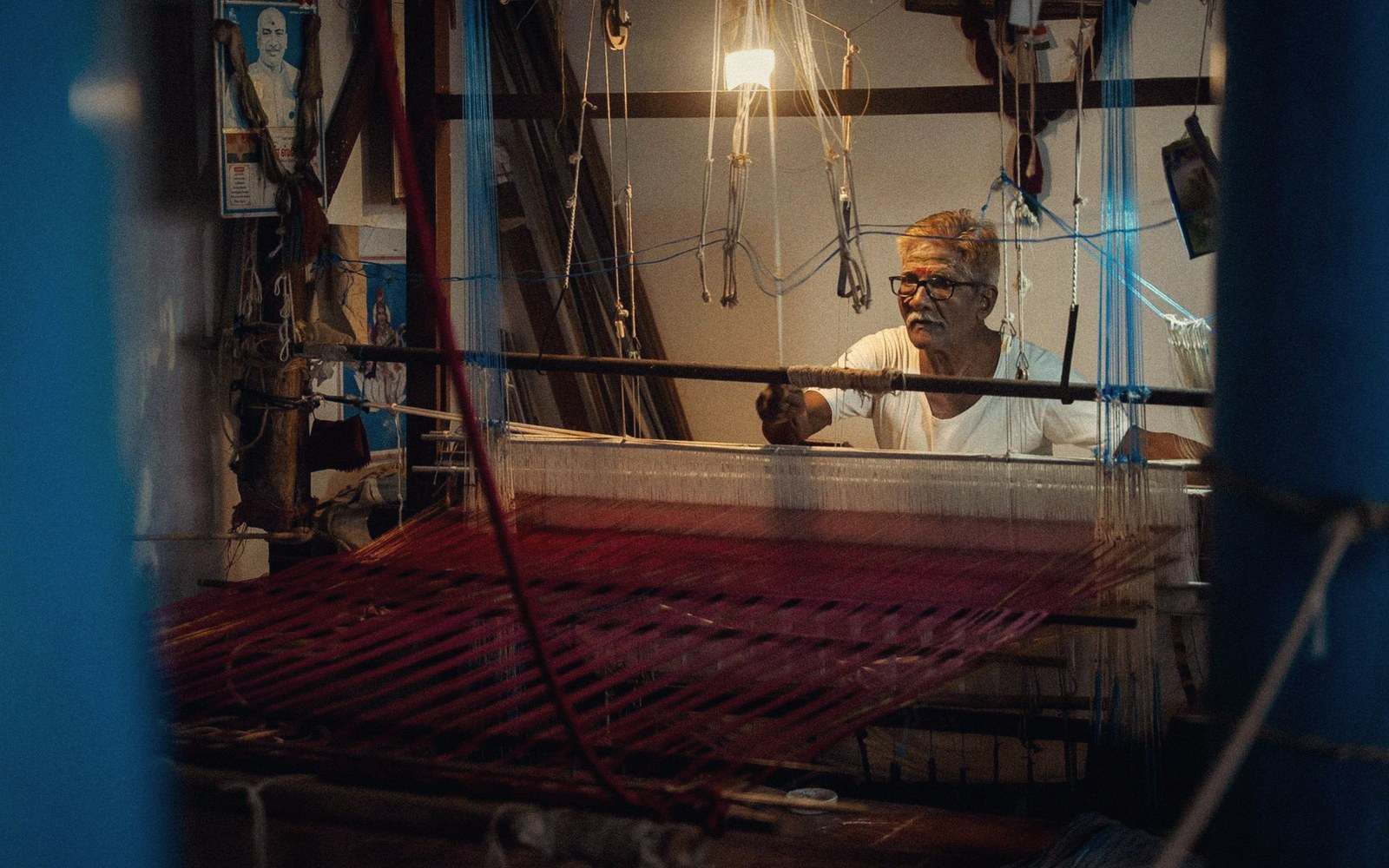
The drawloom breaks through it. Above the main frame, a separate apparatus — in its Indian form refined over centuries of silk work — allows individual warp threads, or precisely defined groups, to be pulled up in any sequence. A second operative, the draw-boy or naksha-bandha assistant, reads a patterning programme tied into cords above and lifts only what the pattern requires, row by row. This selective lifting is the mechanical basis of figured silk weaving: the brocade of Varanasi, the supplementary-weft ornament on Kanjivaram silk. The Jacquard head, introduced to Indian workshops in the nineteenth and twentieth centuries, mechanised the same selection principle with punched cards, but the underlying logic — which warp threads rise and which stay down — is the same logic the drawloom had always followed.
The cloth a loom can make is the direct consequence of the shed it can open.

The pit loom, worked across much of India, is set into a trench in the floor.