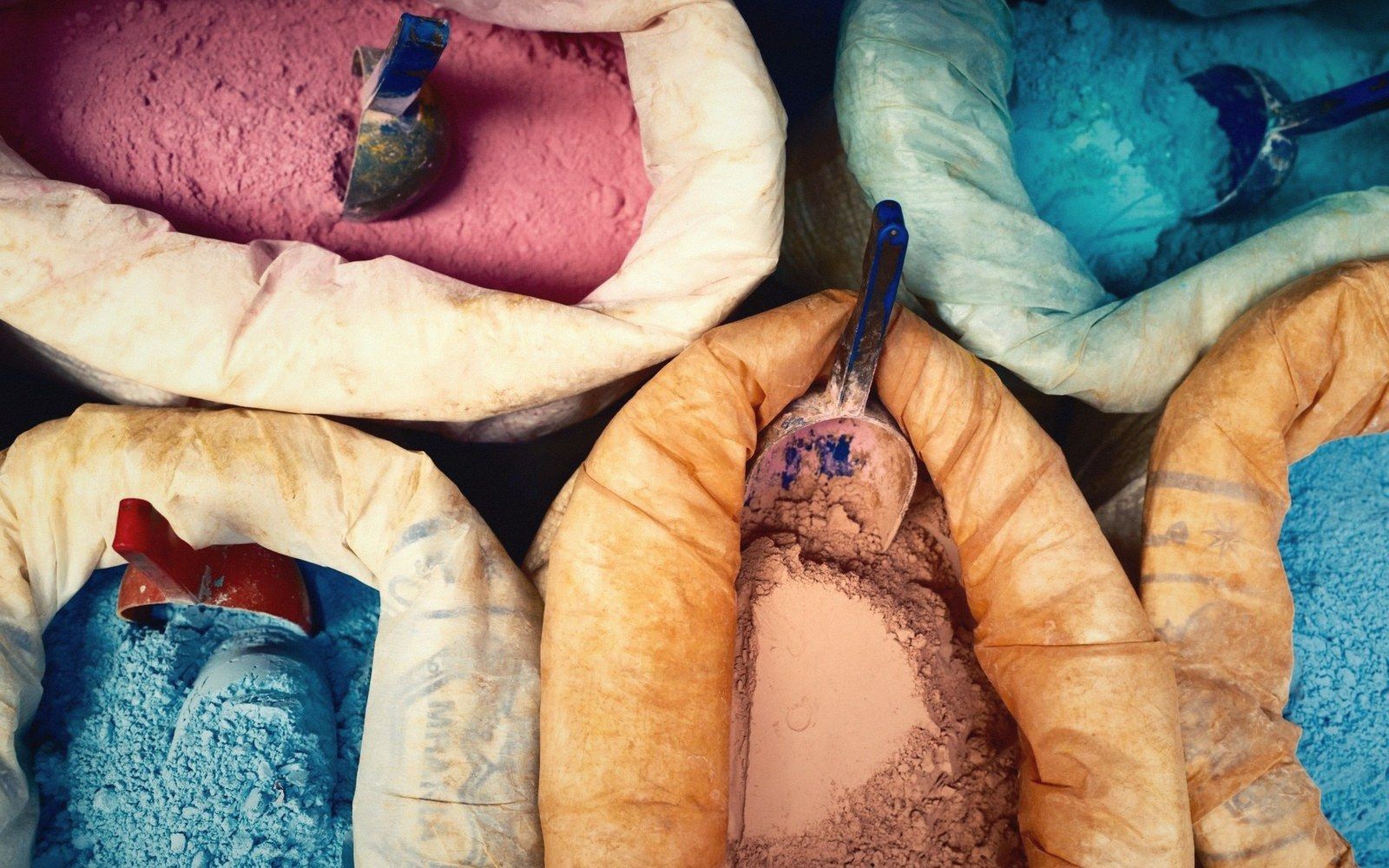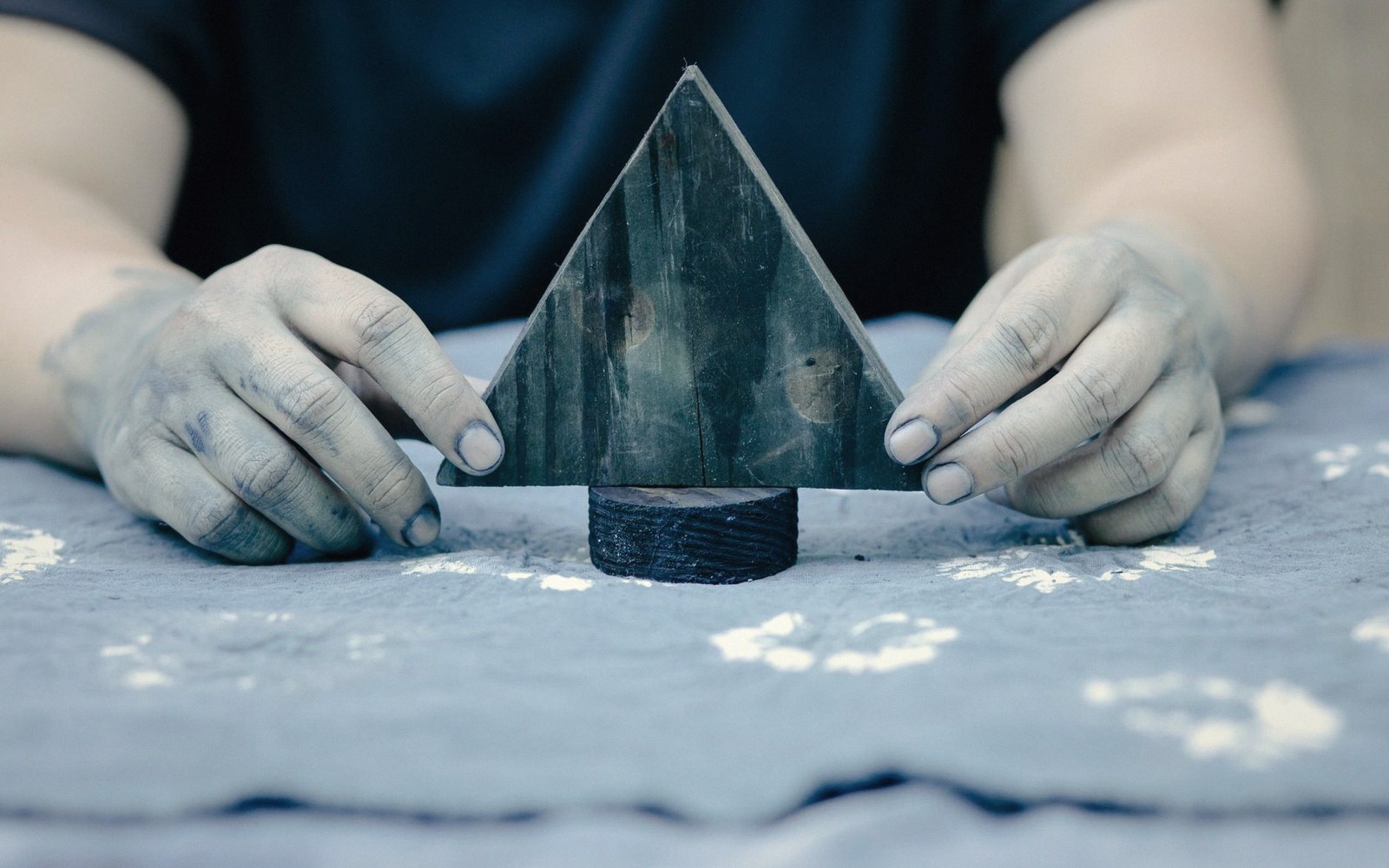
Ajrakh is a block-printed cloth made by the Khatri community in the Kachchh district of Gujarat, and in the Sindh region across the border in Pakistan. The process is not printing in the simple sense of pressing ink to cloth: it is a sequence of resists, mordants, washes and dyes that may run to sixteen or more stages, and the cloth is printed on both faces so the pattern reads cleanly from either side.
01Process and structure
The cloth begins with treatment rather than print. Raw cotton is first washed and beaten to open the fibre, then soaked in a solution of castor oil and soda ash — a process repeated over several days — to make it mordant-receptive. This stage, called saaj, has no visual result; it is entirely preparatory, building the chemistry into the cloth before a block touches it.
What follows is an alternation of resist and mordant printing, dye bath, and rinse. A resist paste of lime and gum is printed onto the cloth to block the ground colour. Then alum and iron mordants are printed into the areas intended to become red and black respectively: alum will fix red from Rubia tinctorum (the madder root), iron will shift the same dye bath toward black. The cloth enters a cold rinse in running water, then a dye bath, then is washed again. At various points it passes through a solution of dhavda flowers — Anogeissus latifolia — which clear the background and intensify the whites by oxidising residual tannins. Indigo is added in a separate bath, building the blue tones that give ajrakh its characteristic palette: deep madder red, near-black, indigo blue and a cleared cream-white ground.
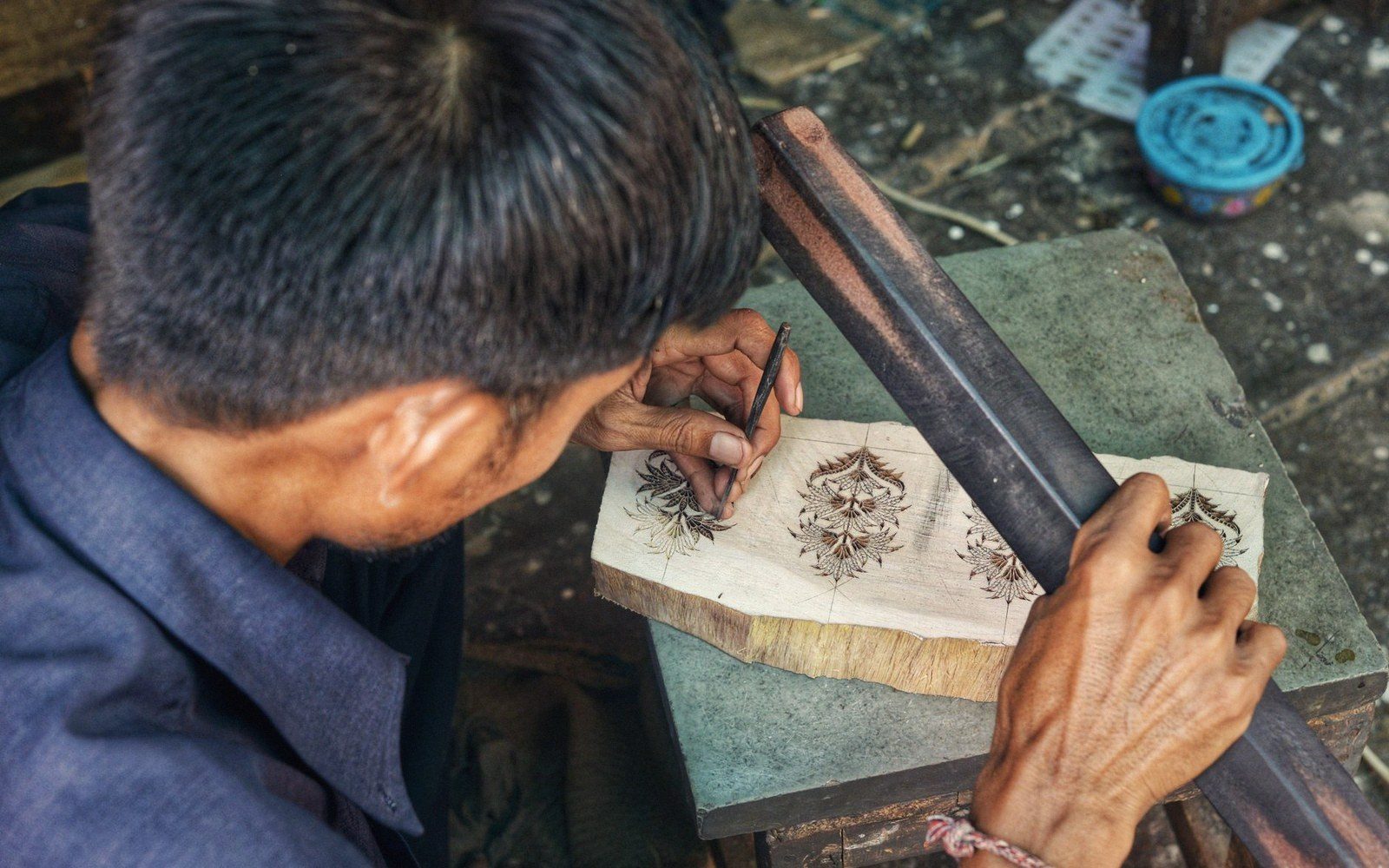
Because the cloth is printed face and back, the blocks for each side must register precisely against one another. The Khatri printer works the second face against the ghost of the first impression, aligning pattern to pattern through the damp cloth. A misregistered ajrakh is immediately legible as a lesser piece; the best work shows no slippage at all. The blocks themselves carry the characteristic geometry of the tradition: interlocking star and medallion forms, dense fill patterns derived from the Arabesque, and a repeating border that frames the field on all four edges. The vocabulary reflects the community's long presence on a trade route that connected the Rann of Kachchh to Persian Gulf ports, and the visual language carries that exchange plainly.
02The Khatri community and its geography
The Khatri are the sole practitioners of ajrakh in India. They worked historically at Dhamadka, a village east of Bhuj, where the river provided the soft water essential to the dye processes — hard, mineral-heavy water interferes with mordant take-up and dulls the final colours. The earthquake of January 2001 devastated Dhamadka, and many Khatri families relocated to a purpose-built settlement at Ajrakhpur, closer to Bhuj, where the craft continues. Some returned to Dhamadka, which has also revived. The parallel tradition in Sindh — made across the province — follows the same logic of process, though regional variations in geometry and colour weight the two bodies of work differently.
Ajrakh has historically been made for use within the communities of Kachchh and Sindh: the large square cloth, perhaps two-and-a-half metres a side, worn as a shoulder cloth or head wrap by men, and used as a bed covering. Specific colourways and border widths could indicate the wearer's community. The cloth's legibility as a social object depended on a shared reading of those signals, now largely disrupted by the market for craft textiles that has reframed ajrakh as a design object for buyers with no connection to that code.
The mordant and dye plants that drive ajrakh's palette — madder and indigo above all — are not grown in Kachchh; they have always arrived through trade. The dependence on alum, iron, soft water and skilled registration means ajrakh cannot be moved or abbreviated without ceasing to be what it is. Every stage depends on the one before it, and the cloth at the end is the sum of a sequence no single step can shortcut.
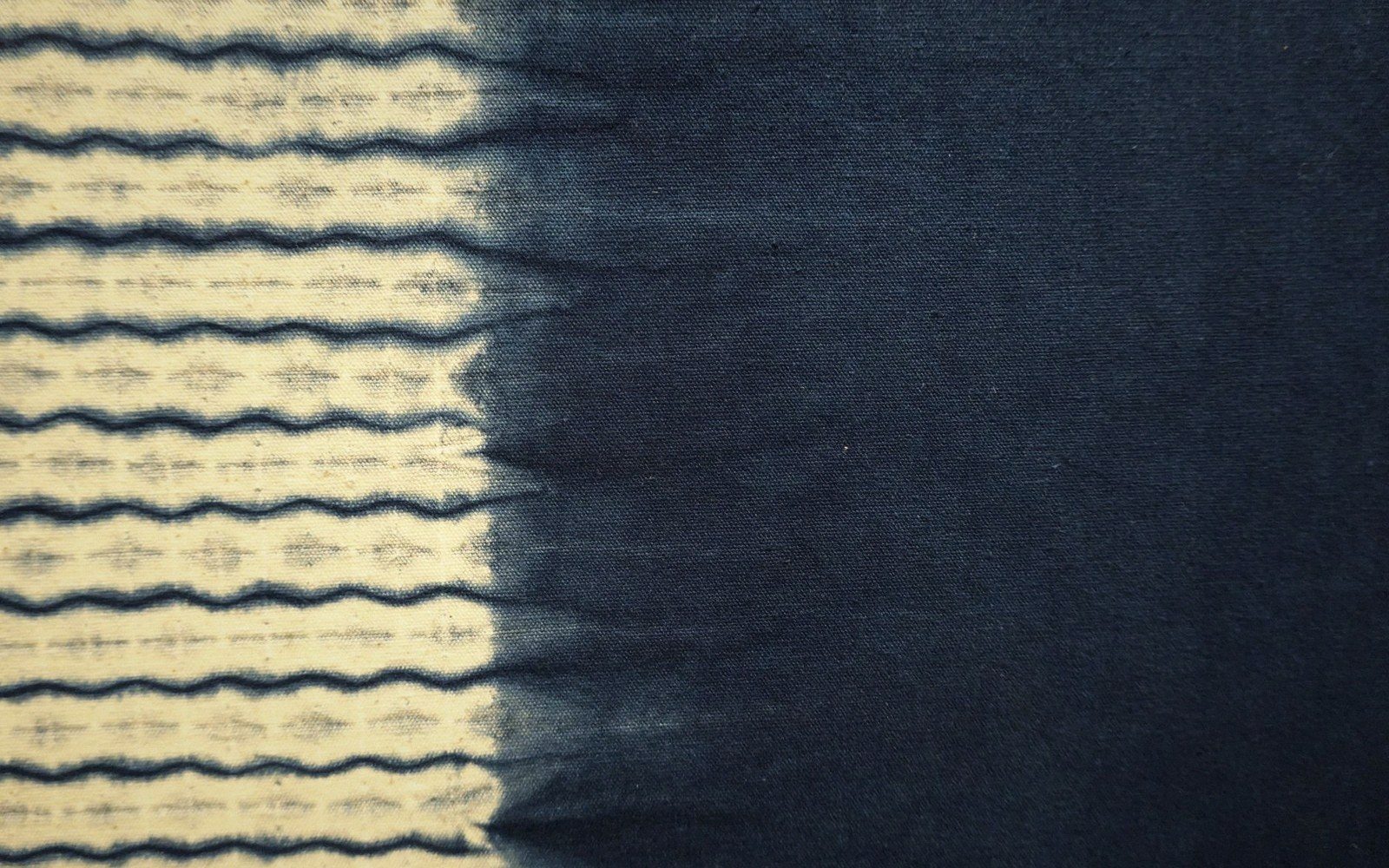
What follows is an alternation of resist and mordant printing, dye bath, and rinse.