Buildings that spoke in two directions simultaneously — to an imperial audience that wanted submission read as loyalty, and to a home audience that wanted power read as continuity.
The princes who survived British paramountcy after 1857 governed states that varied enormously in size, revenue and cultural tradition, yet faced a broadly similar problem: how to build in a period when building was itself a political act. A palace or a durbar hall was always a statement, and the statement had to work for two audiences at once. The British needed to see a compliant, modernising ruler; the ruler's own subjects needed to see a lineage still rooted in its land and gods.
The most direct response was to mix vocabularies within a single structure. At the Laxmi Vilas Palace in Baroda, completed in 1890, the architect Robert Fellowes Chisholm assembled Indo-Saracenic elements — domes, chhatris, arcaded verandahs, sandstone screens — over a plan and structural logic that owed everything to Victorian eclecticism. The scale was deliberate: larger than Buckingham Palace by floor area, the building made a quantitative claim about Baroda's standing within empire. Yet every ornamental register — the mosaic floors, the carved capitals, the trophy courtyard — could be read as continuous with an older Maratha and Rajput tradition of demonstrating sovereignty through lavish construction.
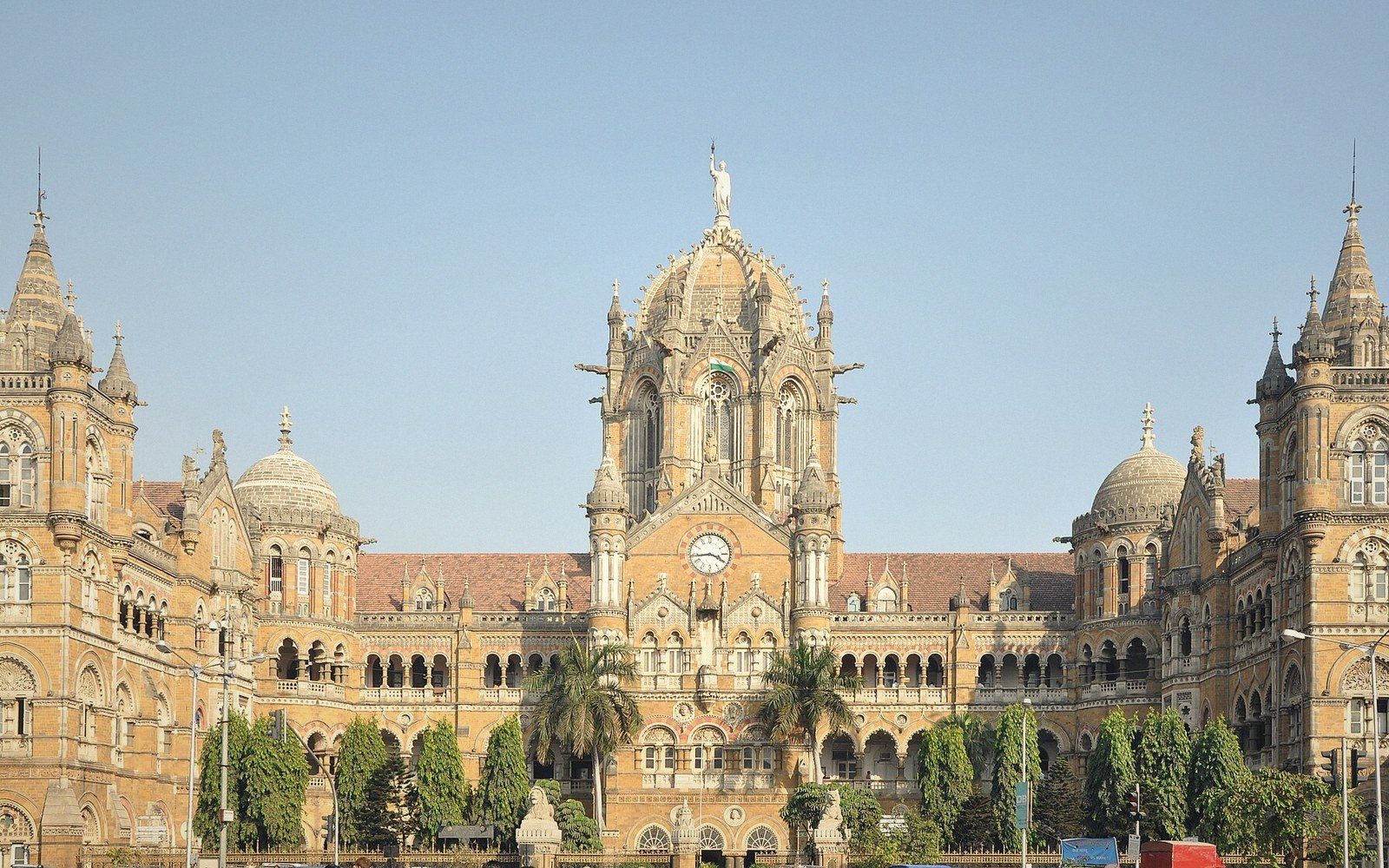
Indo-Saracenic, the style's working name in British India, was partly an architectural category and partly a political instrument. Its theorists, among them Swinton Jacob, who produced the Jeypore Portfolio of Architectural Details in the 1890s, argued that Indian craftsmen had a latent grammar that could be reconciled with modern engineering. Jacob's own work — he advised on or designed buildings across Rajputana — shows how that grammar could be deployed differently depending on who was paying: state buildings for the colonial government leaned on Mughal precedent, while commissions for Jaipur's maharajas drew more heavily on local Rajput form.
01Reading the rooms
Not every princely commission reached for the Indo-Saracenic synthesis. Several rulers went in entirely different directions, and those choices were equally legible. The Umaid Bhawan Palace in Jodhpur, begun in 1929 and completed in 1943, is dressed in the honey-coloured Chittar sandstone that defines Jodhpur's older forts, but its organisation is Art Deco: a central dome, symmetrical wings, interiors designed partly by Stefan Norblin with lacquered murals, terrazzo floors and furniture that would not have looked out of place in contemporaneous Paris or Bombay. It was commissioned in part as a famine-relief project — the building employed local workers during drought — which gave the maharaja a claim to welfare that reinforced rather than undercut the modernity of the design.
In Mysore, the Amba Vilas Palace was rebuilt after a fire in 1897. The architect, Henry Irwin, delivered a building in what he called a Hindu-Saracenic manner, its central tower closely referencing the Hoysala and Vijayanagara architectural traditions of the Deccan, while its steel-framed structure was entirely of its colonial moment. On Dasara, the palace façade is illuminated with tens of thousands of bulbs — a practice that began in the electric era and persists precisely because the spectacle of light mapped onto a recognisably traditional form is readable as both modernity and ritual authority.
The double address was not always comfortable or stable. Rulers who built too Europeanly risked accusations of having abandoned their traditions; those who built too conservatively could be judged as backward by a British administration that used architectural modernity as a proxy for administrative fitness. The buildings that survive as the most satisfying pieces of work are those where the patron and the architect — whether European or Indian — found a genuinely fused formal language rather than a surface compromise. Baroda, Mysore and Jodhpur each represent a different solution to the same problem: how to make a building that answered to empire and to place at the same time, and that still reads as itself.
A palace or a durbar hall was always a statement, and the statement had to work for two audiences at once.